 English
 العربية
 中文語言
中文語言
 हिंदी भाषा
 हespañol
 русский
 Português
 Le français
 Deutsch
 ภาษาไทย
 Português
 日本語
日本語

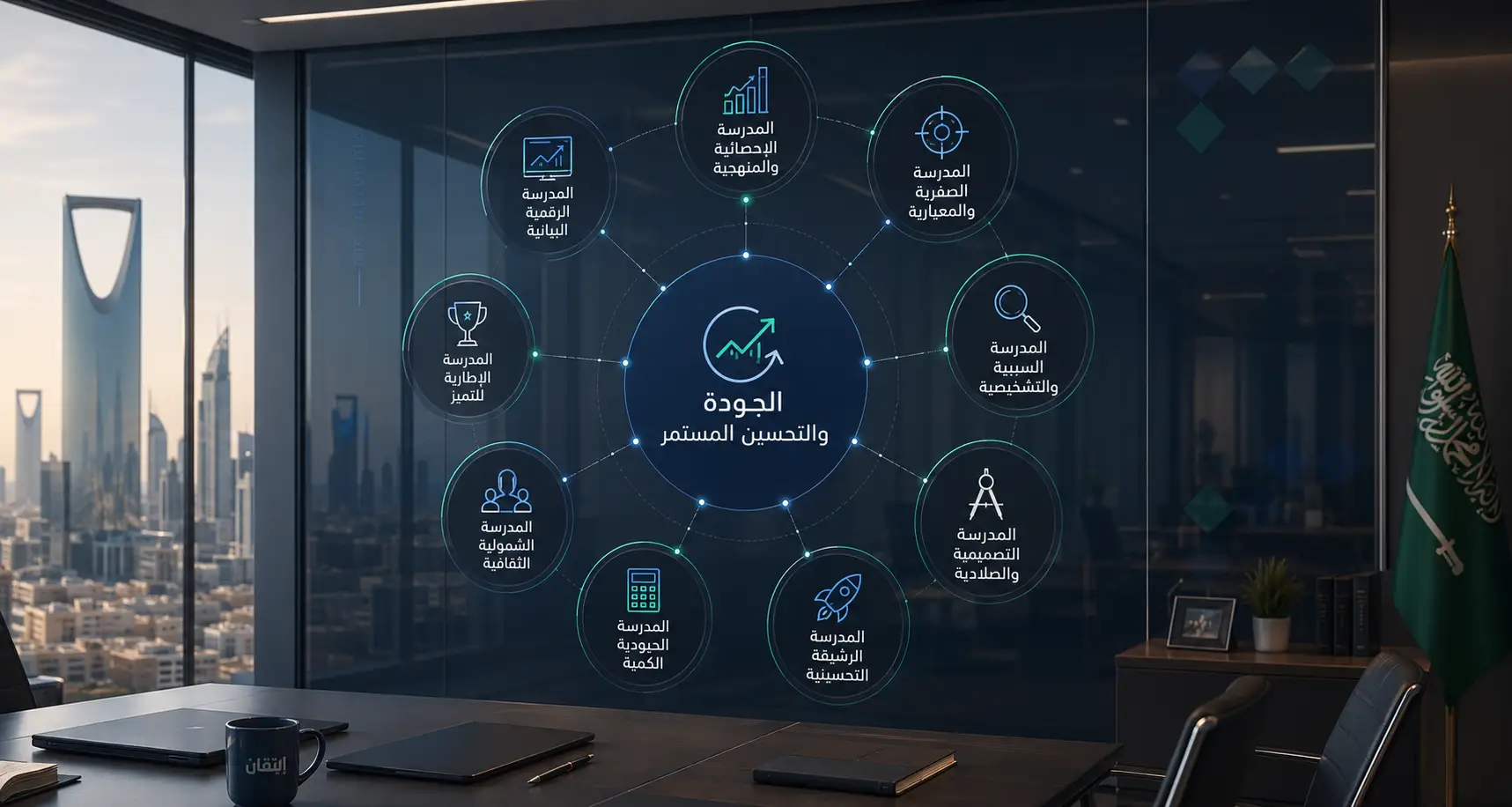
Why “Schools” of Quality Rather Than “Tools” of Quality?
Quality thinking is not merely a toolbox. It is an epistemological perspective that determines how we understand people, processes, outcomes, and value.
A school of thought defines:
What do we improve? The outcome, the process, or the entire system?
How do we improve it? Through statistics, learning, innovation, or empowerment?
Why do we improve it? To achieve customer satisfaction, create value, support sustainability, or generate civilizational impact?
The conclusion: Schools of quality differ in their philosophical foundations, implementation mechanisms, and governance models—not merely in their measurement tools.
1. The Statistical and Systematic School
Shewhart–Deming–Juran
A. Shewhart and Deming
Starting point: The process is the primary subject of quality, and natural variation should be managed rather than entirely eliminated.
Tools: Control charts and the PDCA cycle.
Philosophy: “Improvement from within the system.” Leadership is responsible for approximately 90% of variation.
B. Juran
Starting point: The Quality Trilogy—planning, control, and improvement.
Focus: Building organizational capabilities for quality planning rather than relying solely on control.
Impact: Established the principle that quality is a strategy, not merely an operational activity.
Advantages of this school:
Methodological rigor.
Measurability.
Reduction of variation.
Challenges:
It may reduce quality to a technical exercise if the ethical and empowerment dimensions are absent.
2. The Zero-Defect and Standards-Based School
Crosby
Slogan: “Zero Defects,” and quality means conformance to requirements.
Starting point: Prevention costs less than correction.
Tools: Awareness programs, public management commitment, and measurement of the cost of poor quality.
Advantage:
Clear standards that influence behavior.
Reservation:
There is a risk of restricting innovation if “zero defects” is interpreted literally rather than as a guiding aspiration.
3. The Causal and Diagnostic School
Ishikawa
Starting point: Quality is achieved through employee participation and structured causal thinking.
Tools: The fishbone diagram and the seven basic quality tools, including Pareto charts, check sheets, and histograms.
Culture: Quality circles.
Advantage:
Transforms tacit knowledge into participatory diagnosis.
Reservation:
It requires empowering leadership; otherwise, its application remains superficial.
4. The Experimental and Robustness School
Taguchi
Starting point: Reducing a design’s sensitivity to noise through robust design.
Tools: Orthogonal arrays and the Taguchi loss function.
Advantage:
Quality is built into the design at an early stage.
Reservation:
It requires advanced statistical and design capabilities.
5. The Lean and Improvement School
Kaizen–Lean–Shingo
Starting point: Eliminating waste and improving value flow.
Tools: 5S, Kanban, Kaizen, Poka-Yoke, SMED, and value stream mapping.
Philosophy: Small, continuous daily improvements are more effective than occasional major improvements.
Advantages:
Rapid impact.
Participatory mindset.
Organizational agility.
Reservation:
When tools are implemented without culture, lean management becomes merely “paper-based leanness.”
6. The Quantitative Variation-Reduction School
Six Sigma
Starting point: Reducing defects to 3.4 per million opportunities through DMAIC or DMADV.
Tools: Advanced statistics, root-cause analysis, and process capability measures such as Cpk.
Governance: Green Belts, Black Belts, Master Black Belts, and financially selected projects.
Advantages:
Measurable financial results.
High analytical rigor.
Reservation:
Implementation costs may become excessive if the approach is not linked to strategy and culture.
7. The Comprehensive and Cultural School
Total Quality Management
Starting point: Quality is a system-wide culture and everyone’s responsibility.
Core pillars: Customer satisfaction, employee empowerment, supplier partnerships, and data-driven decision-making.
Advantage:
Extends quality horizontally and vertically across the organization.
Reservation:
It may lose its effectiveness if it is not governed by a mature model and measurement system.
8. The Excellence Framework School
EFQM–Baldrige
Starting point: Institutional excellence is a framework that organizes the relationship among leadership, strategy, value, and results.
EFQM 2020: Purpose-led leadership, sustainable value creation, and improvement through innovation.
Baldrige: Strong criteria for aligning strategy, processes, and results.
Advantages:
Provides a holistic compass.
Enables benchmarking.
Reservation:
It may turn into a “points competition” if its underlying purpose is lost.
9. The Contemporary Digital and Data-Driven School
Starting point: Quality as organizational intelligence, including data quality, predictive analytics, and automation.
Tools: Data Quality, Master Data Management, Process Mining, AIOps, and Digital Twins.
Philosophy: Artificial intelligence-supported improvement and real-time learning and correction.
Advantages:
High operational awareness.
Strong predictive capability.
Reservation:
Risks include biased data and weak governance relating to ethics and privacy.
A Brief Philosophical Comparison
Perspective, Tools, Governance, and Culture
Statistical and systematic school—Deming and Juran: Process first → statistical tools → accountable leadership → learning culture.
Zero-defect and standards-based school—Crosby: Strict conformance → commitment programs → management pledge → behavioral discipline.
Causal and diagnostic school—Ishikawa: Understanding causes → visual tools → empowered teams → participation and improvement.
Design and robustness school—Taguchi: Quality by design → systematic experimentation → R&D integration → early prevention.
Lean and improvement school—Kaizen and Lean: Flow and value → waste elimination → servant leadership → daily habit.
Quantitative variation-reduction school—Six Sigma: Variation reduction → DMAIC → project governance → precise financial outcomes.
Comprehensive and cultural school—TQM: Everyone owns quality → policy system → broad empowerment → commitment culture.
Excellence framework school—EFQM and Baldrige: Holistic compass → maturity criteria → reviews and assessments → strategic improvement.
Digital and data-driven school: Real-time learning → data intelligence → digital governance → agility and anticipation.
Toward a Robust Arab Synthesis
The “Values-Based Analytical Excellence” Model
For Arab and Gulf organizations, we propose an integrated methodology combining:
Values-based excellence: Honesty, integrity, justice, and responsibility, grounded in Islamic references and national values.
Statistics and analysis—Deming and Six Sigma: Data-based decisions and reduced variation.
Lean improvement—Kaizen and Lean: Daily improvement and waste reduction.
The holistic framework—EFQM and Baldrige: Alignment among leadership, strategy, value, and results.
Digital intelligence: Data quality, real-time indicators, and control automation.
The result:
A “Values-Based Analytical Excellence Model” in which ethical values guide the objective, rigorous analysis improves the path, and an excellence framework unifies organizational efforts.
Implementation Guidance: How Do You Select the Most Appropriate School?
Nature of the activity: High-variation manufacturing → Six Sigma; agile services → Lean or Kaizen.
Data maturity: Low maturity → TQM, Ishikawa, or EFQM; advanced maturity → Six Sigma or predictive analytics.
Organizational culture: Formal and hierarchical → Crosby or ISO, supported by preliminary empowerment; collaborative and learning-oriented → Kaizen or Deming.
Strategic ambition: Excellence awards or governance objectives → EFQM or Baldrige as an overarching directional framework.
Application in Education, Healthcare, and Government
Education
Use Ishikawa, TQM, and EFQM to embed a culture of improvement, supported by measurement of learning impact and academic data quality.
Healthcare
Use Six Sigma and Lean for critical processes, risk management, and the improvement of patient pathways.
Government
Use EFQM or Baldrige as maturity frameworks, Lean for services, and data governance to promote transparency and accountability.
From a “School” to an “Awareness”
The most appropriate school is the one that serves your mission, values, and context.
Excellence is not loyalty to a particular doctrine. It is loyalty to truth, results, and people.
When values, analysis, and systems are reconciled, quality emerges as a living organizational awareness that leads to sustainable excellence and meaningful impact.
Note
This article may be republished or used for educational, training, or research purposes, provided that it is attributed to its original source and that its scientific and analytical methodology is preserved.
Prepared by:
Dr. Najwa bint Abdulrahim Shaheen
Trainer, evaluator, consultant, and Chairperson of the Board of Directors of Al-Itqan International Training and Consulting Company.
To access the complete series and further articles on quality:
Add New Comment