 English
 العربية
 中文語言
中文語言
 हिंदी भाषा
 हespañol
 русский
 Português
 Le français
 Deutsch
 ภาษาไทย
 Português
 日本語
日本語

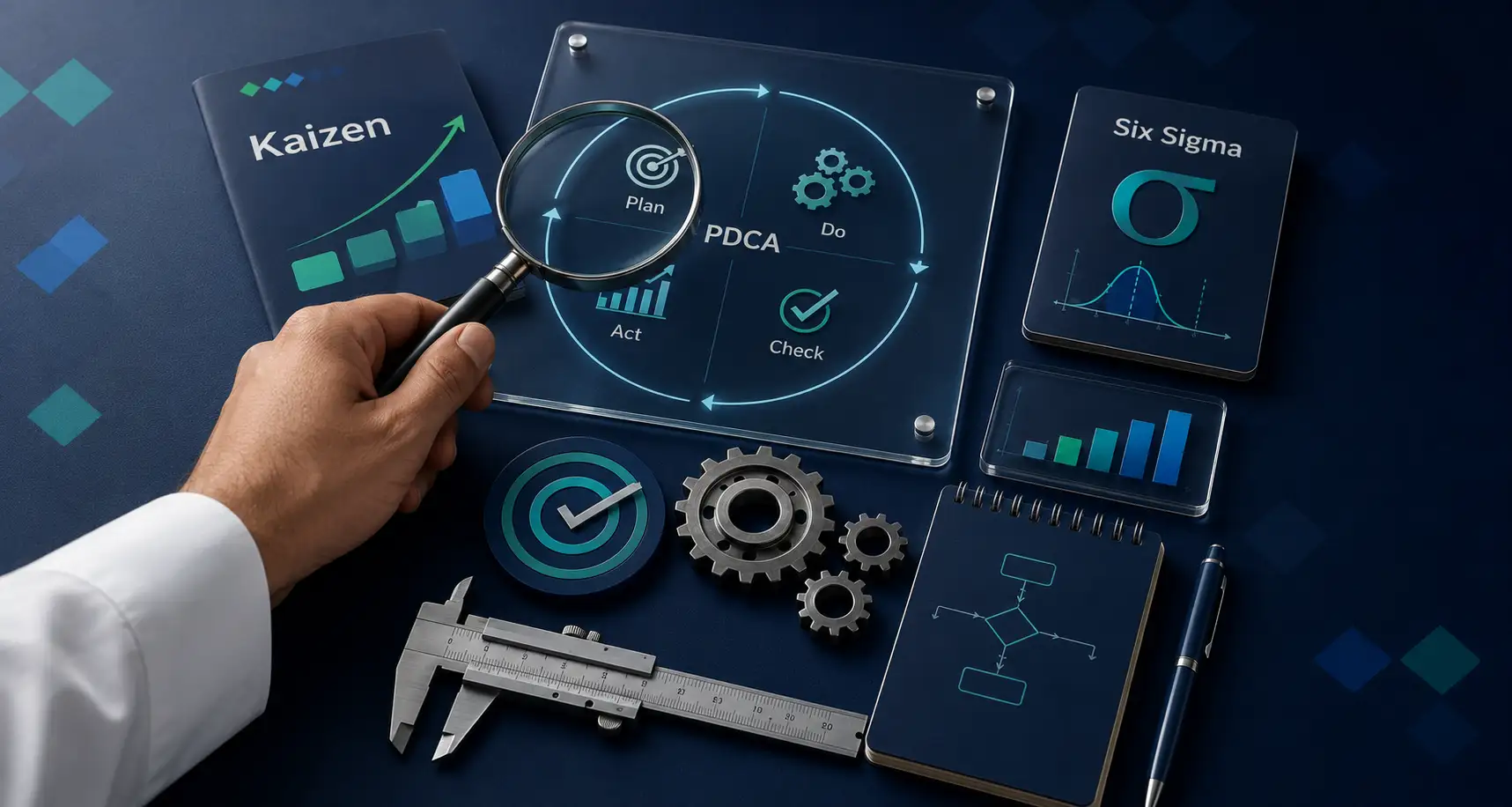
Axis Five: Institutional Improvement Methodologies and Tools(PDCA – Kaizen – Six Sigma)
First: An Introduction to Institutional Improvement as a Performance Philosophy
Institutional improvement is not a supplementary procedure added to administrative work. Rather, it is the dynamic backbone that keeps an organization alive and enables it to learn, adapt, and grow.
Organizations do not excel merely because they establish quality systems. They excel because they transform improvement into a collective work culture in which every process represents an opportunity for enhancement and every employee becomes an agent of change.
In modern management thought, improvement is viewed as a recurring and systematic behavior that integrates logical analysis with practical experimentation. It requires an encouraging leadership environment that embraces the philosophy of excellence rather than a culture of inspection.
Improvement is therefore not merely a reaction to an error. It is a deliberate effort to narrow the gap between what is possible and what has been achieved, and between current and targeted performance.
The philosophy of institutional improvement is based on four fundamental principles:
Continuity: Improvement never stops because change never stops.
Methodology: Every improvement must be grounded in scientific analysis rather than personal impressions.
Empowerment: What is not owned cannot be improved; employees must therefore be empowered to understand their role in development.
Measurement: What cannot be measured cannot be improved, and what cannot be analyzed cannot be properly understood.
Second: The Deming Cycle for Continuous Improvement
PDCA Cycle
The Deming Model is considered a cornerstone of modern improvement thinking.
It is more than a procedural cycle; it is an integrated management thinking system based on scientific experimentation and the principle of continuous organizational learning.
The PDCA Cycle consists of four interconnected stages:
Plan
Planning is the most critical stage. It involves defining the problem, analyzing root causes, and developing improvement hypotheses.
Effective organizations do not rush directly to solutions. They begin by developing a deep understanding of operational reality through analytical tools such as process maps and cause-and-effect analysis.
Do
This stage begins with the limited-scale testing of the proposed solution or process.
Improvement at this stage is not a comprehensive organizational intervention, but a controlled experiment designed to test hypotheses, accompanied by full documentation of the results.
Check
At this stage, implementation results are analyzed and compared with expectations.
Here, the essence of scientific thinking becomes evident: an unsuccessful experiment is not a failure, but a new source of information about reality.
Statistical analysis and quantitative measurement tools are used to evaluate the extent of improvement.
Act
If the solution proves effective, it is standardized and adopted as a best practice.
If it is insufficient, the cycle begins again as part of an ongoing learning process.
In this sense, PDCA is not merely a circle. It is a spiral of growth that moves the organization toward higher levels of maturity and greater awareness of improvement.
Third: The Kaizen Method — The Philosophy of Continuous Small-Scale Improvement
The word Kaizen is of Japanese origin and means “continuous improvement toward the better.”
At its core, however, Kaizen is a philosophy of management and organizational life, not merely a work technique.
It is based on the principle that accumulated small daily improvements are more powerful than temporary radical change.
The Intellectual Principles of Kaizen
Improvement is everyone’s responsibility: From senior management to the most junior employee.
There is no limit to a good idea: Small ideas can create major differences.
An enabling environment: Improvement requires freedom rather than fear of making mistakes.
Development through analysis rather than blame: Failure is used for learning, not punishment.
Practical Kaizen Tools
5S: Sort, Set in Order, Shine, Standardize, and Sustain.
Kanban: A visual flow-management system for processes.
Tools for identifying waste in time and resources, known as Muda.
Daily Kaizen Meetings for continuous improvement.
Institutional Impact
Organizations that adopt Kaizen experience higher levels of belonging, creativity, and responsibility.
Kaizen makes improvement a daily practice and transforms performance into a disciplined journey toward sustainable excellence.
Fourth: Six Sigma — Improvement Through Statistical Analysis
The concept of Six Sigma originated at Motorola in the 1980s and later spread to major organizations such as General Electric.
It is a rigorous scientific methodology designed to minimize process variation and defects to the lowest possible level—approximately 3.4 defects per million opportunities.
Six Sigma, however, is not merely a statistical tool. It is a management and improvement system driven by quantitative analysis and scientific thinking.
The methodology is based on two principal models:
A. DMAIC
For Improving Existing Processes
Define: Define the problem, objectives, and critical-to-quality variables (CTQs).
Measure: Measure the current state using numbers and data.
Analyze: Analyze the root causes of deviations.
Improve: Develop and improve processes based on the analysis.
Control: Stabilize the results and document the improvements to preserve the gains.
B. DMADV
For Designing New Processes
This model is used when developing new systems and focuses on designing processes correctly from the outset to prevent defects.
The Organizational Structure of Six Sigma
Green Belts and Black Belts: Professionals and leaders specializing in improvement projects.
Strategic management support: Links improvement initiatives to financial objectives.
A data-driven culture: Decisions are based on statistics rather than impressions.
Institutional Impact
Six Sigma creates a culture of analytical rigor and precision in which efficiency is measured objectively and processes are managed scientifically.
It teaches organizations that improvement does not occur by chance, but results from a systematic equation combining analysis, implementation, and discipline.
Fifth: Interaction Among the Three Methodologies — From Behavior to System
These methodologies are not competing alternatives. Rather, they are complementary circles representing three levels of improvement:
PDCA: A method of thinking and analysis — the improvement mindset.
Kaizen: A method of daily behavior and practice — the improvement culture.
Six Sigma: A method of structured methodology and measurement — the improvement system.
When these three levels are integrated, they form what may be called an Integrated Improvement System.
This is the approach adopted by leading organizations around the world in industry, education, healthcare, and the public sector.
Sixth: Improvement Leadership
Without conscious and capable leadership, improvement tools are reduced to slogans.
An improvement-oriented leader does not merely issue instructions. Rather, the leader creates an environment that enables people to improve their own work.
The principal characteristics of improvement leadership include:
Empowerment: Granting employees the authority to initiate improvements in their work.
Encouraging learning from mistakes: A documented mistake becomes a laboratory for learning.
A shared improvement vision: Every small improvement contributes to a larger strategic objective.
Motivation through meaning: Connecting improvement to the human significance of excellence and mastery.
Seventh: The Al-Itqan Model for Sustainable Institutional Improvement
Drawing on global experience and Arab civilizational values, an integrated model may be developed under the title:
The Al-Itqan Model for Sustainable Institutional Improvement
(Itqan Model for Sustainable Improvement)
The model is based on five pillars:
1. Purpose
Clarifying the organization’s purpose and linking it to the broader value it creates for society.
2. Analysis
Relying on data and scientific thinking to identify areas requiring improvement.
3. Engagement
Involving all organizational levels in designing and implementing improvement.
4. Empowerment
Providing employees with the freedom and responsibility to implement improvement initiatives.
5. Sustainability
Stabilizing improvements and converting them into performance standards and an enduring organizational culture.
This model reframes improvement from a mere “quality system” into a sustainable, value-based managerial awareness that places excellence at the center of organizational existence.
In Conclusion
Institutional improvement is not a project with a beginning and an end. It is a journey of awareness that begins in the mind and culminates in organizational culture.
PDCA gives you the thinking.
Kaizen gives you the spirit.
Six Sigma gives you the methodology.
What unites them all is Itqan—excellence and mastery: the value that transforms work from performance into a mission, achievement into impact, and an organization into a model of quality.
Note
This article may be republished or used for educational, training, or research purposes, provided that appropriate attribution is given to its original source and that its scientific and analytical methodology is preserved.
Prepared by:
Dr. Najwa bint Abdulrahim Shaheen
Trainer, Assessor, Consultant, and Chairperson of the Board of Directors of
Al-Itqan International Training and Consulting Company
To access the complete series and further articles on quality:
Add New Comment