 English
 العربية
 中文語言
中文語言
 हिंदी भाषा
 हespañol
 русский
 Português
 Le français
 Deutsch
 ภาษาไทย
 Português
 日本語
日本語

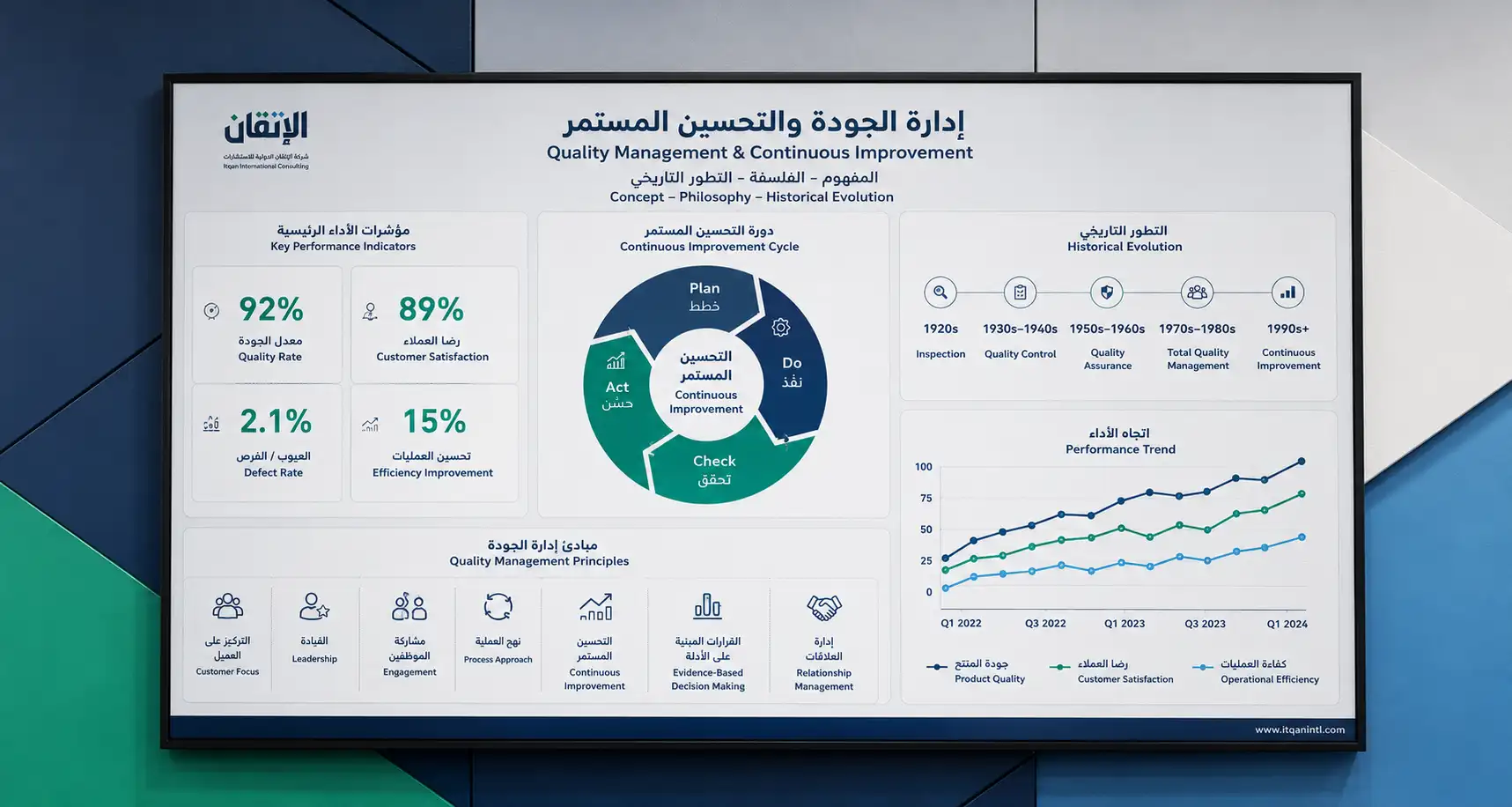
Historically, the concept of quality began as an inspection practice aimed at identifying and controlling errors. It then gradually evolved into a discipline based on systems, management, and analysis. With the development of management thought and the emergence of operations and production management schools, the need arose for methodologies that ensure the continuous improvement of performance and connect the quality of a product or service with the quality of the people who deliver it.
Continuous improvement is not merely a means of control. It is an enduring philosophy embedded in every detail of planning, implementation, and evaluation. It originates from an institutional awareness that connects leadership, culture, values, and results. In the Arab context, quality has acquired a developmental dimension aligned with national vision objectives, particularly in Saudi Arabia and the Gulf states, where quality has become a standard for measuring institutional maturity and excellence in both government and private-sector performance.
This article aims to present an integrated intellectual and methodological perspective on quality management and continuous improvement by reviewing their historical development, management philosophy, and position within the institutional excellence system. It is aligned with international frameworks such as EFQM, ISO, and CIPD and reflects leading Gulf experiences in this field.
The following topics will be addressed:
- The general concept of quality management and continuous improvement
- The management philosophy of excellence and mastery
- The historical development of quality thinking from inspection to sustainability
- Schools of management thought in quality and continuous improvement
- Tools and methodologies for institutional improvement: PDCA, Kaizen, and Six Sigma
- Quality in educational and learning organizations
- Gulf and Arab experiences in quality management
- Anticipating the future of quality and continuous improvement in the Arab world
Theme One:
The General Concept of Quality Management and Continuous Improvement
Quality management and continuous improvement are among the most comprehensive and profound management concepts in modern institutional thought. They combine precise scientific methodology with a refined human philosophy that elevates mastery as an ethical, behavioral, and professional value.
At its core, quality is not merely a collection of procedures or organizational forms designed to improve performance efficiency or control products. It is an integrated intellectual vision that redefines the relationship between people and work, between institutions and their outputs, and between objectives and results. It is a concept that extends beyond technical measurement to a value-based dimension encompassing thought, behavior, practice, and attitude.
Linguistically, the Arabic word for quality, jawdah, derives from the root letters meaning improvement, mastery, and excellence. It signifies striving to achieve the best possible standard in every action and outcome. In technical usage, definitions of quality vary according to different intellectual and management schools. Nevertheless, they converge on one central principle: achieving the optimal alignment between what is provided and what is expected—between performance and need, and between outputs and aspirations.
The International Organization for Standardization, ISO, has defined quality as the overall ability of a set of inherent characteristics in a product or system to meet specified or expected requirements. The European quality perspective regards it as a set of planned and organized activities used to provide confidence that a product or service will meet its requirements. In modern management thought, however, quality is not understood as a final destination but as a continuous process of improvement and innovation integrated into every level of institutional work.
Within this context, continuous improvement represents the natural and practical extension of the quality principle. It refers to an ongoing movement toward better performance based on monitoring results, analyzing gaps, addressing deviations, and continuously developing processes without interruption. Continuous improvement is not limited to correcting errors. It involves building an institutional culture that treats quality as an endless journey—one that begins with awareness, matures through practice, and continues through commitment and empowerment.
Quality management and continuous improvement therefore constitute a strategic management framework that reshapes working methodologies within organizations. Quality is transformed from a specialized function into a comprehensive system connected to every organizational unit, operational process, and leadership role. It is a vision that makes every employee a partner in building quality, every process an opportunity for improvement, and every challenge a starting point for further development.
Modern quality management is characterized by its preventive rather than merely corrective approach. It seeks to anticipate problems before they occur through prior analysis and strategic prevention. It is also based on empowerment, granting employees the authority and responsibility to improve their individual and collective performance. This strengthens their sense of belonging and creates voluntary commitment to excellence. Quality therefore intersects with governance, motivational leadership, and performance management to form an integrated system of balanced organizational thinking.
An examination of the intellectual dimensions of quality reveals three fundamental pillars:
- The knowledge dimension, based on a scientific understanding of systems, procedures, specifications, and international standards.
- The behavioral dimension, reflected in organizational values such as honesty, commitment, professional integrity, and discipline.
- The creative dimension, manifested in the ability to think analytically and innovatively design improvement solutions.
These three dimensions combine to create what may be described as “institutional quality awareness.” This awareness enables an organization to recognize that quality is not the responsibility of a particular department or administrative unit. Rather, it is the spirit of the institution, flowing through every decision, procedure, and human interaction within it.
Quality management and continuous improvement are not restricted to factories or material production environments. They extend to service, educational, medical, developmental, and community institutions. When quality becomes a general mode of thinking that guides collective behavior, institutions become capable of creating a qualitative difference in their performance and in the quality of life they provide to their employees and communities.
In the academic context, educational quality represents one of the most profound applications of this concept. Educational institutions continuously seek to improve their outcomes by developing curricula, preparing and qualifying teachers, enhancing learning environments, and measuring the impact of education on learners and society. This extension from administrative quality to educational quality demonstrates the depth of the concept and its flexibility in adapting to different sectors.
Quality management and continuous improvement may therefore be regarded as the practical embodiment of the philosophy of mastery in work—a philosophy encouraged in Islam centuries ago in the saying of the Prophet Muhammad, peace and blessings be upon him:
“Indeed, Allah loves that when one of you performs a task, they perform it with mastery.”
Mastery here is not merely a worldly objective. It is a civilizational and spiritual value that forms the ethical conscience of professional practice. Quality in Arab and Islamic thought therefore acquires a civilizational depth that extends beyond administrative standards to the highest human meaning.
When applied in its comprehensive depth, this concept creates a fundamental transformation in institutional performance. Quality ceases to be a temporary project and becomes a sustainable system that links strategic planning, professional development, and the continuous measurement of performance. This distinguishes leading organizations, which do not regard quality merely as an evaluation criterion but as an enduring administrative and intellectual way of life directed toward excellence and continuous improvement.
Dr. Najwa bint Abdulrahim Shaheen
Trainer, arbitrator, auditor, consultant, and General Manager of Al-Itqan International Company for Training and Consulting.
For further insights and specialized knowledge, we invite you to subscribe to the WhatsApp channel of Al-Itqan International Company for Training and Consulting through the following link:

Add New Comment